


Laparoscopic (Keyhole) Spey vs Traditional Spey in Dogs
A guide for owners deciding between keyhole and traditional spey surgery — what each involves, how recovery differs, and what to expect on the day.
What is a laparoscopic (keyhole) spey?
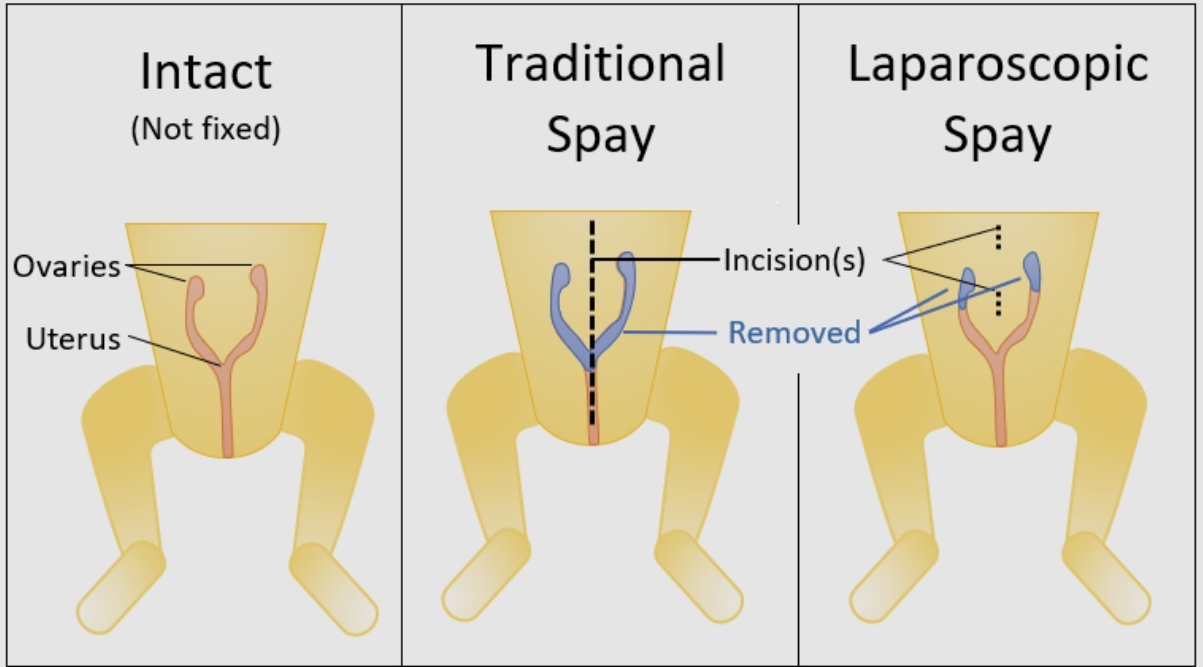
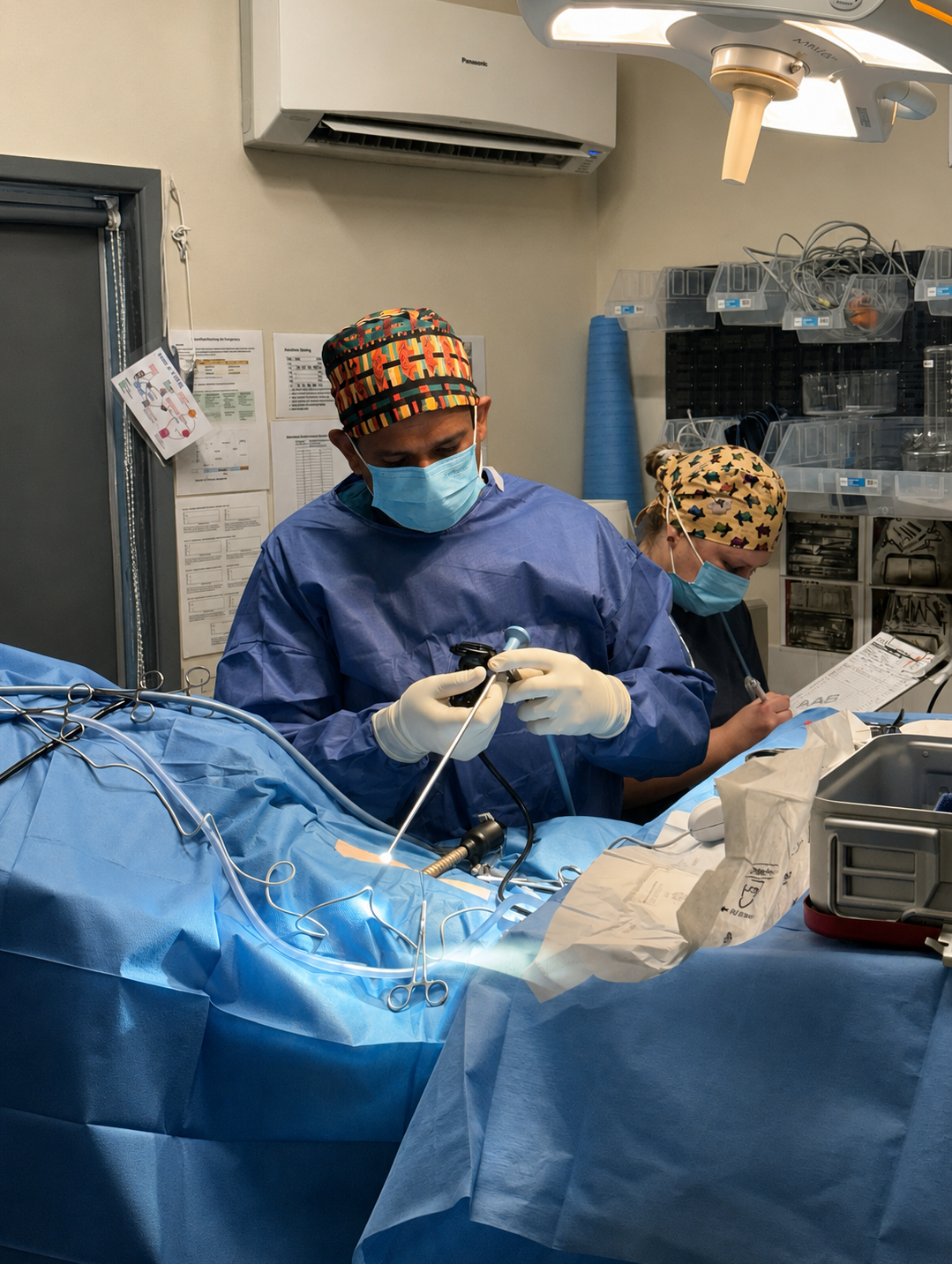
A laparoscopic spey is a modern “keyhole” technique that uses a tiny camera and fine instruments placed through two or three small incisions in your dog’s abdomen. The surgeon watches a magnified image of your dog’s internal organs on a screen, allowing very precise and gentle handling of tissues.
In contrast, a traditional spey is an “open” surgery where a longer incision is made on the abdomen so the surgeon can see and remove the reproductive organs directly.
Why consider a laparoscopic spey?
Studies in dogs show that laparoscopic speys are safe and use smaller incisions, with less internal tissue handling and fewer adhesions (internal scar tissue) than open surgery. Research and clinical experience suggest many dogs having laparoscopic speys show lower pain scores and return to normal activity faster.
Many owners choose a keyhole spey because they want a less invasive option, smaller scars, and a potentially more comfortable recovery for their dog.
How will the scars look?
Laparoscopic (keyhole) spey
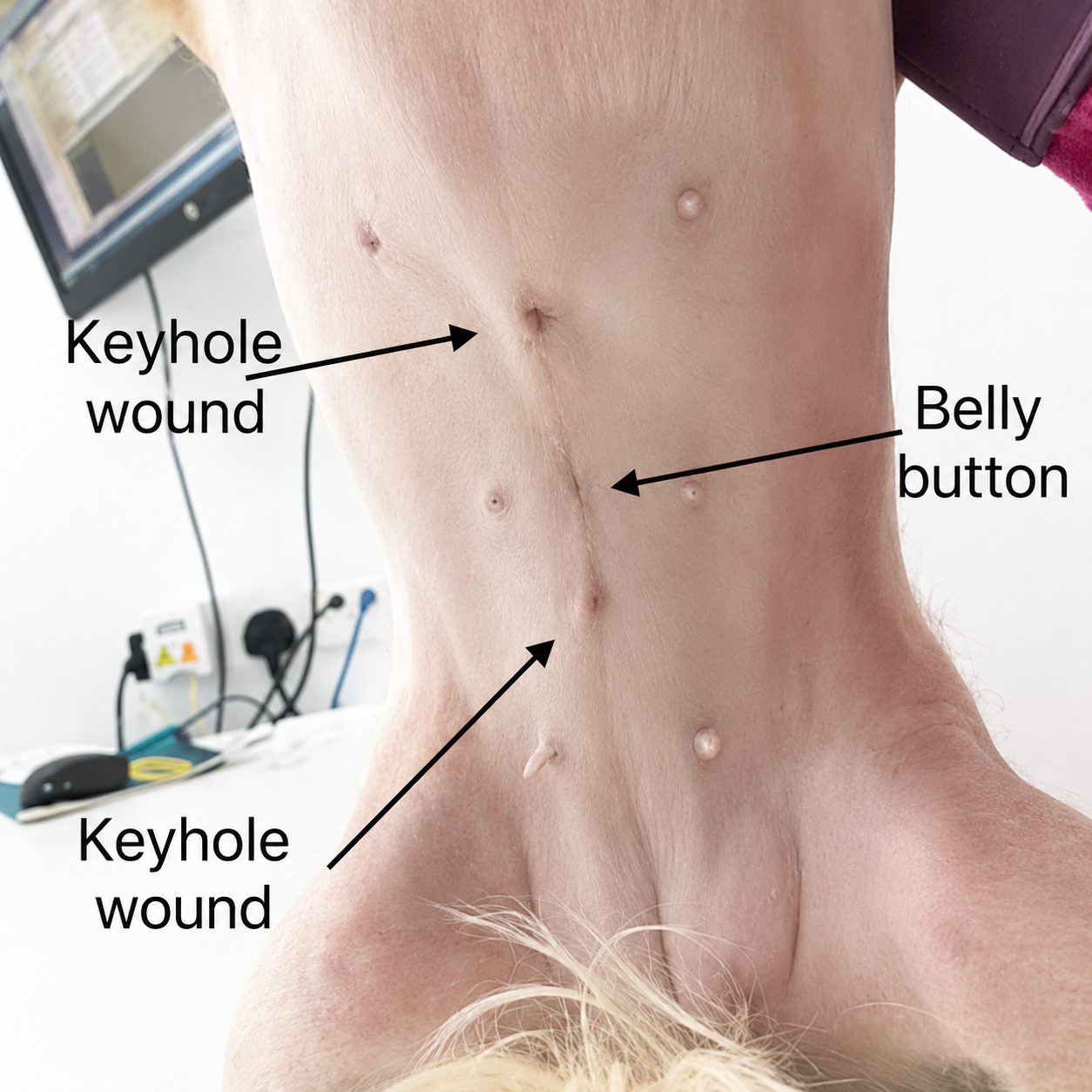
- Usually 2–3 small incisions (often around 0.5–1.5 cm each), on or near the midline.
- Total length of all scars is significantly shorter than a traditional spey.
- The cosmetic result is often more discreet once healed.
Traditional (open) spey
- A single longer incision on the underside of the abdomen, commonly around 4–10 cm depending on your dog’s size and the specific procedure.
- More sutures in the skin and a more visible line scar while healing.
Every dog heals differently, but owners often report that keyhole wounds look smaller and are harder to see once the hair has grown.
Important: pre‑surgical clipping
Because laparoscopic surgery relies on very clean, camera‑guided access into the abdomen, a larger area of hair needs to be clipped than for a traditional spey.
For a laparoscopic spey, the clipped area usually:
- Runs from just behind the ribcage to in front of the back legs.
- Extends more widely across the sides of the abdomen to allow safe placement of multiple ports and room to move the instruments.
For a traditional spey, the clipped patch is often narrower and centred over the single midline incision. This more extensive clipping for laparoscopy is normal and temporary. In some dogs, especially long‑coated breeds, the coat can take several weeks to look fully even again.
Pain and recovery – What to expect?
Research comparing laparoscopic and open speys in dogs shows that, on average, dogs having a laparoscopic spey show less pain in the early postoperative period and get back to normal activity sooner. Activity monitoring studies have shown that dogs speyed laparoscopically lose less activity after surgery than those having open surgery.
After a laparoscopic spey, many dogs:
- Are brighter and more comfortable sooner after going home.
- Need a shorter period of strict rest (often a few days of restriction rather than two full weeks), although some activity control and lead‑walking are still required.
After a traditional spey, most dogs:
- Need 10–14 days of rest and controlled exercise to protect the larger incision.
- Require more careful monitoring of the wound for swelling, redness, or discomfort.
With both methods, modern pain‑relief protocols are used to keep your dog as comfortable as possible.
Is a keyhole spey suitable for every dog?
Laparoscopic spey is an excellent option for many dogs, but not all. Reasons your vet might recommend a traditional spey instead include:
- Very small dogs where there is limited space for instruments.
- Dogs where even a slightly longer anaesthetic would be undesirable because of other health problems.
- Dogs with uterine disease (for example, pyometra) where removal of the uterus as well as the ovaries is required and open surgery is preferred.
- Some previous abdominal surgeries or unusual anatomy.
Your vet will discuss your dog’s age, size, breed, general health, and any specific reproductive concerns before recommending the best option.
Chance of converting from keyhole to traditional spey
It is important to understand that sometimes a laparoscopic procedure needs to be converted to a traditional open spey during the operation. Conversion is not considered a complication; it is a decision made to keep the patient safe when visibility or access is not ideal. Published conversion rates around 20–23 percent are reported for more complex laparoscopic procedures in small animals, though rates for routine laparoscopic speys in healthy dogs are typically lower.
Reasons a surgeon may convert to an open spey include:
- Unusual or unexpected anatomy (for example, an ovary or uterus in an abnormal position).
- Bleeding is better controlled through a larger open incision.
- Difficulty safely accessing or removing structures with keyhole instruments.
If conversion is needed, the incision is extended and a standard spey is completed. Your dog is still fully and safely desexed; it simply means recovery and scar will be more like a traditional spey.
Risks and complications
All surgeries and anaesthetics carry some risk, regardless of the method used.
Possible issues with laparoscopic spey include:
- Injury to internal organs (such as the spleen) during placement of ports or instruments, though this is uncommon in experienced hands.
- Temporary gas under the skin (subcutaneous emphysema) from the carbon dioxide used to gently inflate the abdomen.
- Bleeding from the ovarian blood vessels that may sometimes require conversion to open surgery for best control.
Possible issues with traditional open spey include:
- Internal or external bleeding.
- Wound infection or wound breakdown at the incision site.
- Higher rates of internal adhesions because of the larger incision and more tissue handling.
Serious complications are uncommon with either technique when performed by trained veterinary surgeons using appropriate monitoring and pain‑relief protocols.
Brief comparison
Table 1. Brief Comparison
| Feature | Laparoscopic (Keyhole) Spey | Traditional Open Spey |
|---|---|---|
| Incisions and scars | 2–3 small incisions, shorter total scar length, often more discreet when healed | Single longer incision on the midline, more visible during healing |
| Pain and comfort | Often less early postoperative pain and quicker return to normal activity | Well controlled with modern pain relief, but usually more discomfort in the first few days |
| Recovery period | Often a few days of restriction before returning to normal | Typically, 10–14 days of strict rest and controlled exercise |
| Clip area | Larger area of coat clipped over the abdomen and sometimes the sides | Smaller, narrower clipped area over the midline |
| Possibility of conversion | Small chance of changing to open surgery during the procedure if needed for safety | Already an open procedure; no conversion needed |
| Internal tissue handling | Less manipulation and fewer adhesions | More manipulation and higher adhesion rates |
Common client questions
Will my dog still be fully desexed with a laparoscopic spey?
Yes. In most laparoscopic speys, the ovaries are completely removed, so your dog cannot come into season or become pregnant, and the main long‑term health benefits of desexing are maintained.
Is keyhole surgery completely pain‑free?
No surgery is completely pain‑free, but the aim is always to keep your dog as comfortable as possible. Laparoscopic speys often cause less early postoperative pain than open speys, and both procedures are supported with modern pain‑relief protocols.
What if I choose keyhole and the vet needs to convert to a traditional spey?
If visibility, anatomy, or bleeding make a traditional spey safer, the surgeon will extend the incision and complete a standard open spey. Your dog will still be fully desexed. The aftercare and restrictions will then follow the open‑surgery instructions.
How Daisy Hill Vet can help
Daisy Hill Vet offers both laparoscopic (keyhole) and traditional open speys so the team can tailor the procedure to your dog’s needs and your preferences. The surgeons have specific training in minimally invasive techniques and use modern monitoring and pain‑relief protocols for every patient. If you are thinking about booking a spey for your dog, please chat to our team.
We are happy to go through:
- Whether laparoscopic surgery is suitable for your dog.
- The differences in clipping, scarring, recovery, and cost.
- Any questions or concerns you have about either procedure.
